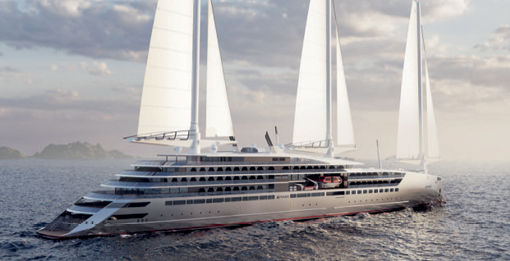
PONANT is unveiling details of the cruise line’s 14th vessel, which was foreshadowed earlier this year (CW 24 May). The cruise line’s research & development team have designed the transoceanic sailing ship, which combines six “groundbreaking” technologies, to aim for zero carbon emissions. Swap2Zero’s sail power system and hull will...
PONANT is unveiling details of the cruise line’s 14th vessel, which was foreshadowed earlier this year (CW 24 May).
The cruise line’s research & development team have designed the transoceanic sailing ship, which combines six “groundbreaking” technologies, to aim for zero carbon emissions.
Swap2Zero’s sail power system and hull will provide an average of 50% of the propulsion energy using the force of the wind, and will also utilise more than 1,000m2 of photovoltaic panels, with new generation organic solar “eco-designed” devices integrated into the structures and sails.
Two sail propulsion systems are being considered: the Ayro Oceanwings technology (render pictured top), and the Solid Sail technology (render pictured below at right).
Swap2Zero will also feature one low-temperature fuel cell operating on liquid hydrogen for propulsion, with the water and heat produced to be recycled; and one high-temperature fuel cell to meet the hotel load requirements, with the heat emitted being recovered and used to produce hot water.
On-board carbon capture technology and an innovative energy management system will also be used to control and distribute power, free of generators.
Swap2Zero will be ready by 2030, Ponant says, although a shipyard has not yet been selected for her delivery.
With around a hundred staterooms and a length of 181 metres, Swap2Zero will be in line with new European and international regulations on greenhouse gas emissions.
The selection of equipment and materials for Swap2Zero’s construction will be based on an analysis of their life cycle through to the recycling of waste.
Ponant is heading up the Swap2Zero project with a focus on the potential for replicability, to speed up the decarbonisation of the shipbuilding industry.
Swap2Zero will also be part of the Ponant Science program, hosting researchers involved in decarbonisation technologies.
“By 2030, our future ship aims to have zero greenhouse gas emissions when sailing, manoeuvring, in port or at anchor,” Chief Executive Officer Herve Gastinel declared.
“Her carbon footprint will be reduced throughout her life cycle…renewable energy supplied by the wind and sun will be combined with low-carbon non-fossil energy associated with fuel cells.
“This is much more than a new ship…we want to offer a new mode of navigation and actively contribute to decarbonisation of the maritime sector.”